
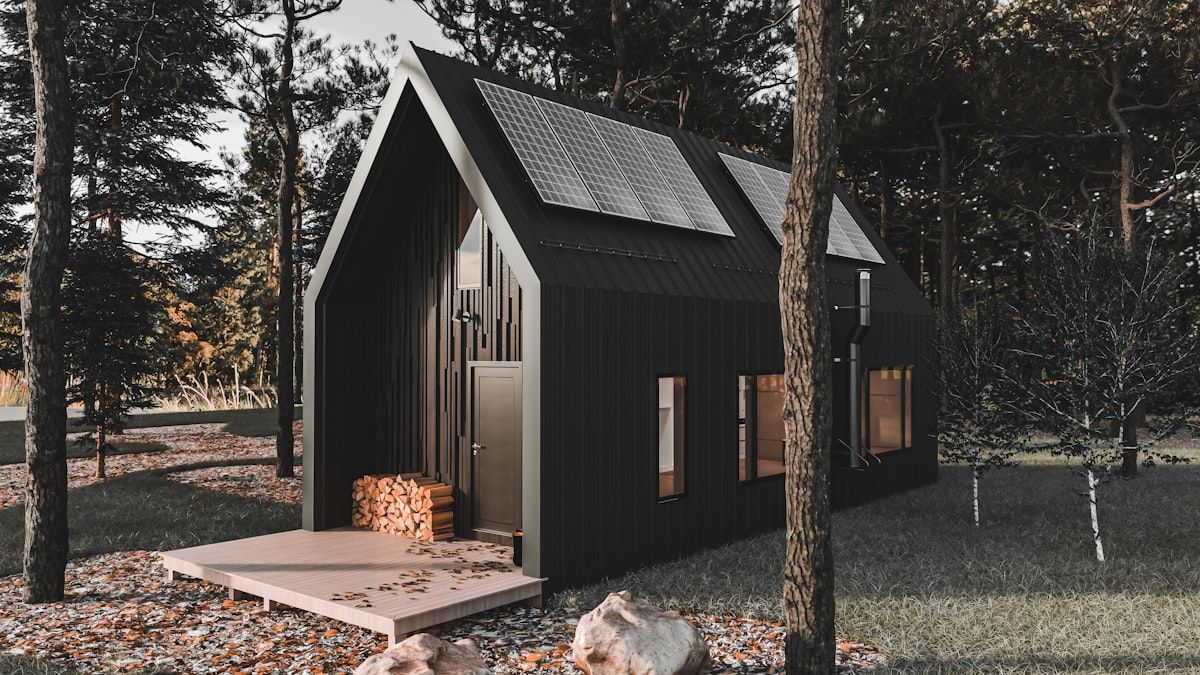
Why dimensions matter more in a tiny home
In a conventional home, a poorly planned room is an inconvenience. In a tiny home, it can make the entire space unliveable. Every centimetre carries weight — the difference between a kitchen you can actually cook in and one you can only reheat takeaway in often comes down to 30 cm of counter depth or 60 cm of circulation space.
Whether you are planning a container conversion, a compact apartment in Hong Kong, or a purpose-built micro-dwelling, the numbers below are the non-negotiables.
Minimum ceiling heights
Ceiling height has an outsized psychological effect in small spaces. Aim for at least 2.7 m wherever possible. This gives you room to use loft sleeping platforms — which typically require a minimum of 900 mm clearance above the mattress for comfortable sitting — while maintaining adequate headroom below.
For loft beds accessed by a ladder or alternating-tread stair, the practical breakdown is:
- Mattress thickness: 150–200 mm
- Seated headroom above mattress: 900 mm minimum, 1,000 mm preferred
- Platform structure and floor finish: 150–200 mm
- Clearance below platform for standing: 1,950 mm; for a desk zone: 1,200 mm minimum
Total double-height requirement for a usable loft: approximately 3.2–3.5 m. If your ceiling is lower, the loft becomes storage-only territory.
Kitchen: the most dimension-critical space

The kitchen is where most tiny home designs fail. A galley kitchen — the most space-efficient layout — requires a minimum 900 mm aisle width between facing counters. For two people to work simultaneously, 1,050 mm is significantly more comfortable.
Key kitchen dimensions to lock in early:
- Counter depth: 600 mm standard; 550 mm acceptable in extreme constraints
- Counter height: 850–900 mm
- Under-counter appliance zone: 820 mm clear height
- Sink minimum width: 450 mm single bowl; 600 mm for a 1.5 bowl
- Hob clearance to overhead cabinet: 650 mm minimum, 750 mm preferred
- Overhead cabinet depth: 300–350 mm
A compact but fully functional galley kitchen can be achieved in as little as 2.4 m in length with apartment-sized appliances — 450 mm wide dishwashers and two-burner induction hobs make a significant difference.
Bathroom: absolute minimums

Bathroom dimensions are the hardest to compress without sacrificing usability. The internationally recognised absolute minimums for a functional wet room are:
- Shower enclosure: 800 × 800 mm minimum; 900 × 900 mm comfortable
- WC frontal clearance: 600 mm minimum, 750 mm practical
- WC side clearance: 200 mm from centreline to side wall minimum
- Basin: 400 mm wide minimum; wall-hung saves floor space
- Door swing: 700 mm clearance arc — consider a sliding or pivot door
A wet room combining shower and WC can be achieved in as little as 1.4 m × 1.6 m, but at this scale every fixture position must be resolved in 3D before construction begins.
Sleeping: bed dimensions vs room dimensions
Standard bed sizes are often treated as fixed, but in a tiny home they deserve scrutiny:
- Single / Twin: 920 × 1,900 mm
- Double / Full: 1,370 × 1,900 mm
- Queen: 1,520 × 2,030 mm
- King: 1,830 × 2,030 mm
You need a minimum 600 mm circulation clearance on at least one side and the foot of the bed. A queen pushed against two walls with a 600 mm aisle on the accessible side requires a room footprint of only 2.1 m × 2.7 m — surprisingly achievable. Murphy beds recover the entire floor area when folded but require 300–400 mm of wall depth for the housing unit.
The 37 m² benchmark and final thought

Research into compact living consistently identifies 37 m² as the threshold below which every design decision becomes significantly more consequential. Below this area, every square metre allocated to one function is directly taken from another.
In Hong Kong’s nano-flat context — where units of 18–26 m² are increasingly common — the dimensions above become absolute constraints rather than guidelines. The difference between a well-dimensioned home and an uninhabitable one is often a single decision made (or not made) at schematic stage.
The most common mistake in tiny home design is optimising for floor area on a plan drawing. A well-proportioned 20 m² space with 2.8 m ceilings, a long diagonal view, and carefully considered thresholds can feel genuinely spacious.
Design to human dimensions first. The floor area will follow.